To thin thick regular nail polish, use a nail-polish thinner approved for that formula, following its own directions. Do not substitute remover or acetone: OPI's Dutch product guidance explicitly advises against both. First check that the bottle needs thinning rather than simply mixing.
The useful question is not “What household liquid can I add?” It is “Which product is this, what has changed, and does its maker approve a thinner?”
Decide what is wrong before adding anything
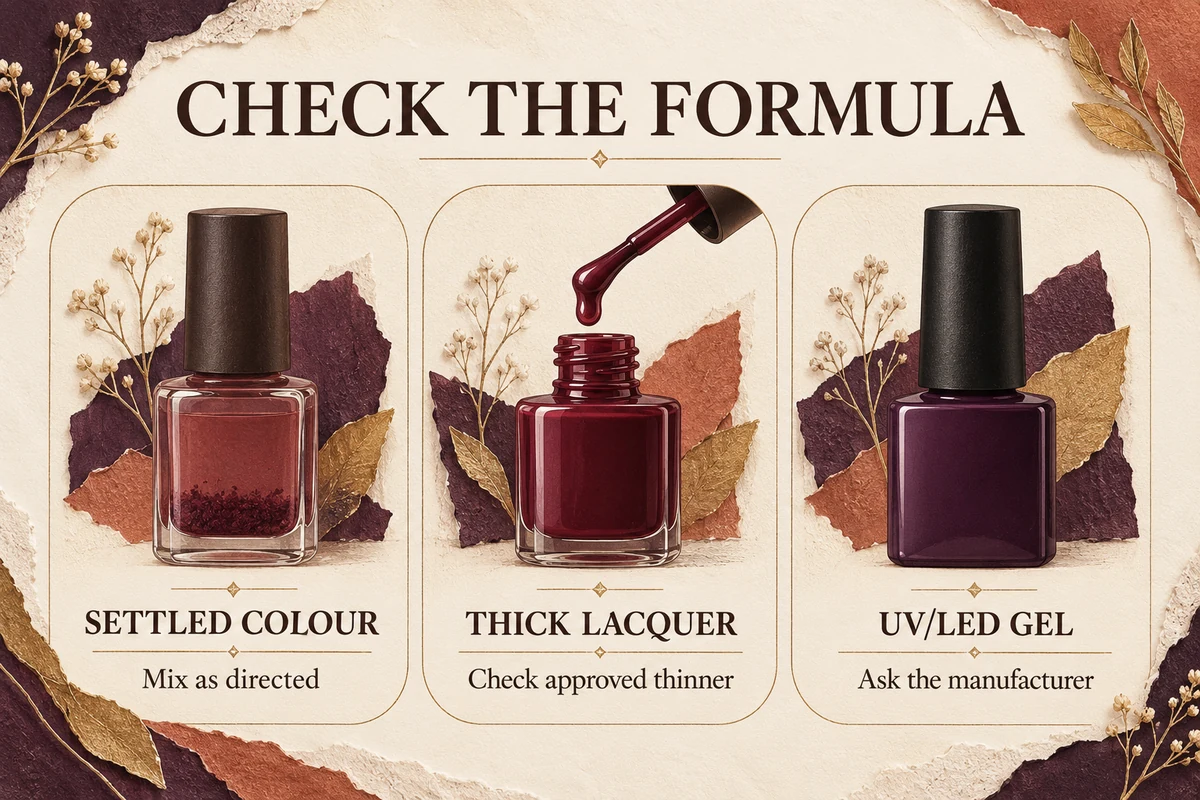
Thickening, settled colour and a changed gel product are different problems. Adding liquid before identifying the problem risks losing the bottle you wanted to save. Start with its label and normal appearance, then use this decision:
| What you see | First action | What to avoid |
|---|---|---|
| Colour has settled, but the polish still flows normally | Follow the maker's mixing instructions | Assuming every separated bottle needs thinner |
| Regular polish is unusually thick or stringy | Check for an approved thinner and its directions | Pouring in remover, water or oil |
| The bottle is labelled UV/LED gel | Ask its manufacturer about the change | Using a regular-lacquer rescue recipe |
| You cannot identify the formula | Find the label or ask the maker before altering it | Guessing from the bottle colour or brand alone |
Keep the bottle closed while you check the instructions. A favourite shade is worth a short pause before an irreversible addition.
There is no universal drop count
Published instructions are not identical. Keo Supply's thick-polish guide gives a 2–3-drop starting example. OPI's Dutch Nail Thinner page says about 6 drops, followed by rolling the bottle between your hands. These are attributed examples, not two measurements to average.
OPI identifies Nail Lacquer, Infinite Shine and Nature Strong as compatible families on that page. It does not turn the product into a thinner for every bottle carrying the OPI name. Check your actual formula and current instructions; the article cannot identify them for you.
A practical sequence is:
- Read the polish and thinner labels together and confirm compatibility.
- Add only the amount instructed for those products.
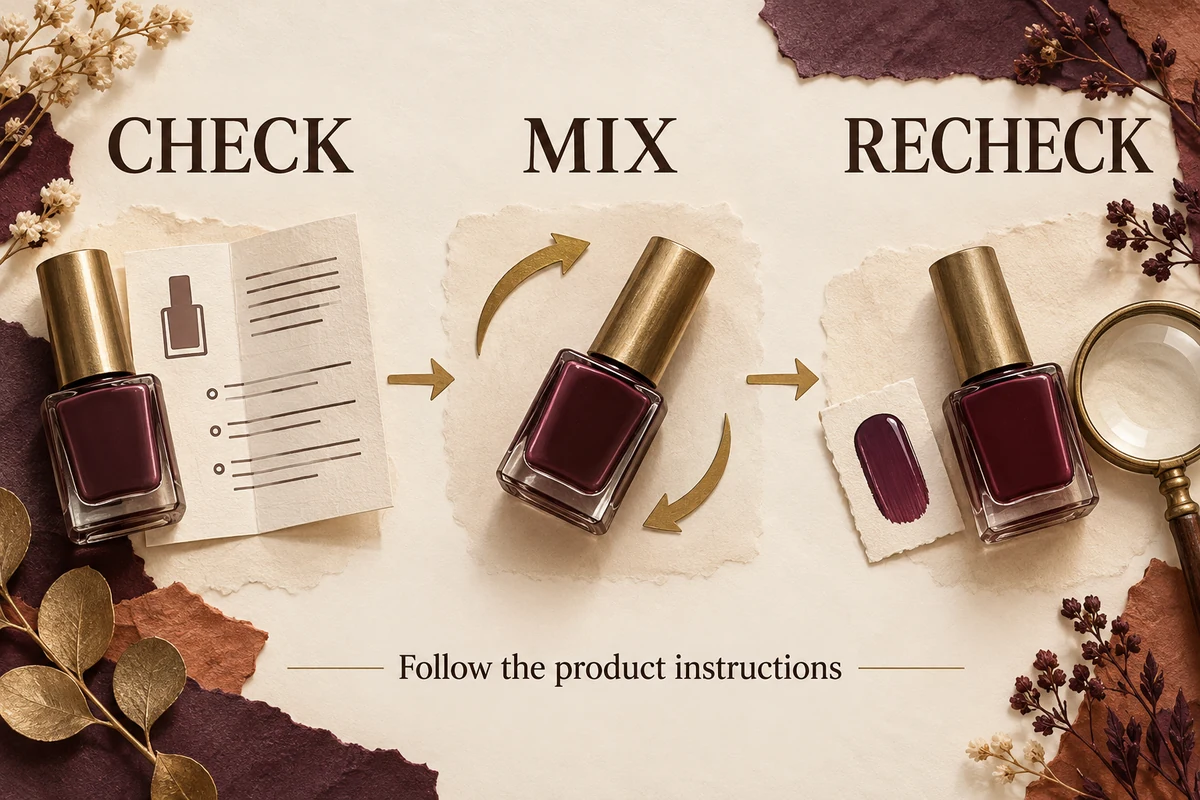
- Close and mix in the way the manufacturer specifies.
- Check the consistency before considering another addition.
- Stop if the product still behaves abnormally rather than adding more by habit.
This is a decision sequence, not a new mixing formula. More thinner is not automatically a better repair.
Do not confuse thinning with mixing
Mixing redistributes what is already in the bottle. Thinning adds another product. If settled pigment returns to its usual appearance after the prescribed mixing, that does not establish a need for an additive.
Equally, shaking or rolling a genuinely thick bottle does not tell you which thinner is compatible. Read the maker's directions instead of treating all bottles alike. Our polish-storage guide explains why formula-specific advice matters even before a bottle goes wrong.
For colour experiments, mixing two polish colours is a separate task. A thinner should not be chosen to create a different shade, opacity or finish.
Keep the next bottle easier to use
OPI's guidance recommends cleaning the bottle neck after polishing and keeping lacquer out of direct sunlight. A clean neck matters because dried product can interfere with closing the cap properly; Keo also flags air exposure in its explanation of thickening.
Keep the care instructions with the bottle rather than memorising a social-media rule. OPI's thinner page also carries flammability warnings: keep it away from heat and ignition sources and out of children's reach. Do not try to speed a repair with a flame or improvised heating.
If you would rather book nail care, Mesmerising Beauty's manicure and pedicure page describes the current services. Use the live treatment list for selection and booking at 77 High Street, Gosforth. A booking does not imply that the salon repairs customers' polish bottles or uses the brands cited here.
For the wider coating choice, compare regular polish and gel polish before buying a rescue product.
Frequently asked questions
Q: Can I add nail polish remover to thick nail polish?
A: Use the maker-approved thinner instead. OPI's published guidance specifically says not to use remover or acetone to thin its lacquer.
Q: Is a stringy bottle definitely expired?
A: Texture alone does not give you a reliable expiry date. Identify the formula, check its label and ask the manufacturer if the change is unexplained; do not keep diluting a bottle that remains abnormal.
Q: Can regular nail-polish thinner go into gel polish?
A: Do not assume so. Gel is a different product system; use its manufacturer's instructions rather than transferring a regular-lacquer method.