To file natural nails, choose a file intended for them, decide the length and outline, then refine the free edge gently and check your work from several angles. Keep edge shaping separate from buffing the nail's surface. Manucurist's filing guide makes that tool distinction; OPI's shaping tutorial repeatedly checks the front, underside and sides.
The goal is a comfortable edge you meant to create, not a perfectly matched set achieved by continually shortening the next nail.
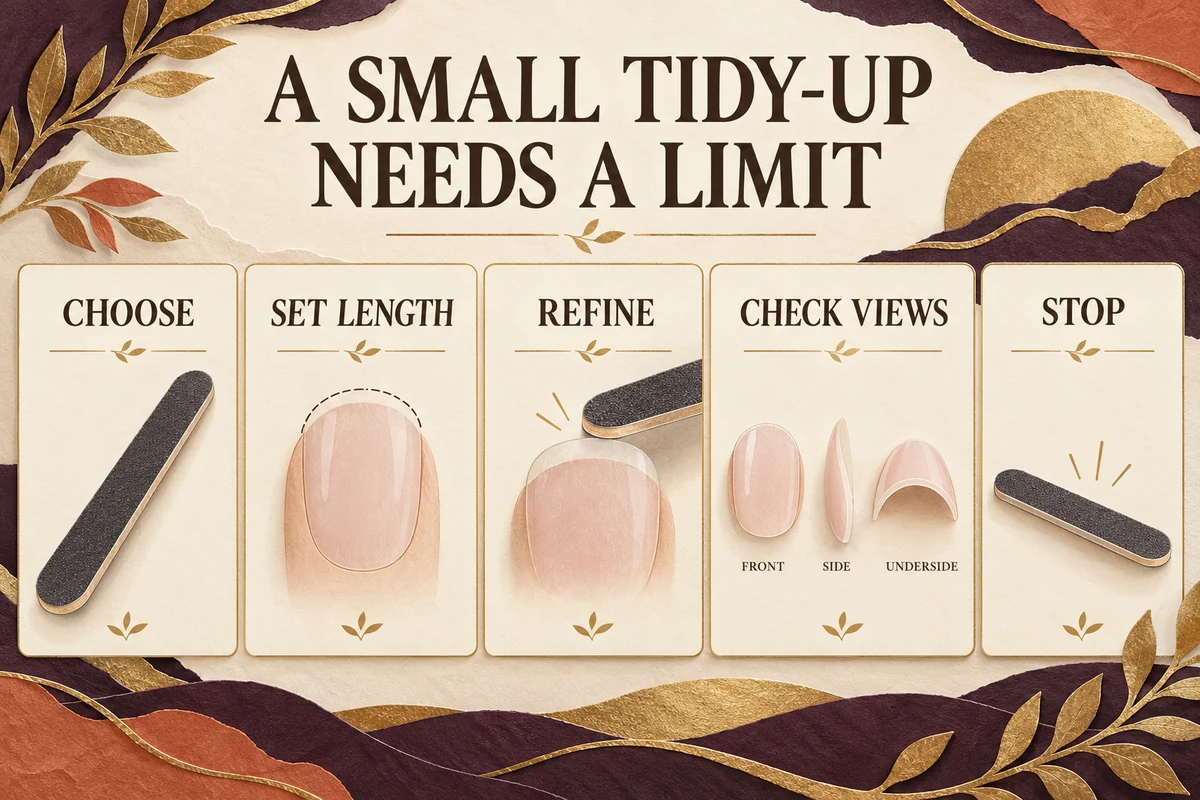
Set a stopping point before the first stroke
Look at your nails together and decide what matters most: keeping length, smoothing one rough edge or changing the outline. Those are different jobs. For a small tidy-up, do not quietly turn “smooth this corner” into “reshape every nail”.
Use this simple sequence:
- Check that the file is intended for your natural nails and follow its directions.
- Decide the shortest length you are willing to finish with.
- Work gently on the exposed edge, removing a little at a time.
- Check from above, underneath and the side before continuing.
- Stop when the agreed edge is achieved rather than chasing absolute symmetry.
The CDC's nail-hygiene guidance also says to clean grooming tools before use. A file's cleaning method depends on its material; do not assume a disposable board can be washed like a glass file.
Match the tool to the job
Manucurist distinguishes natural-nail files, glass files, a cushioned file and a separate priming tool. Its guide assigns different abrasive grades to different products and uses. That is more useful than treating a single grit number from a video as suitable for every nail.
Read the product's instructions and use a tool intended for the task. An edge file shortens or changes the outline; a buffer works on a surface or finish. You do not need to file across the nail plate simply because you are shaping the tip.
For its natural-nail filing routine, Manucurist advises gentle, one-direction movements. Follow the instructions for the file you own rather than applying heavy pressure or copying a professional enhancement-removal technique onto a natural nail.
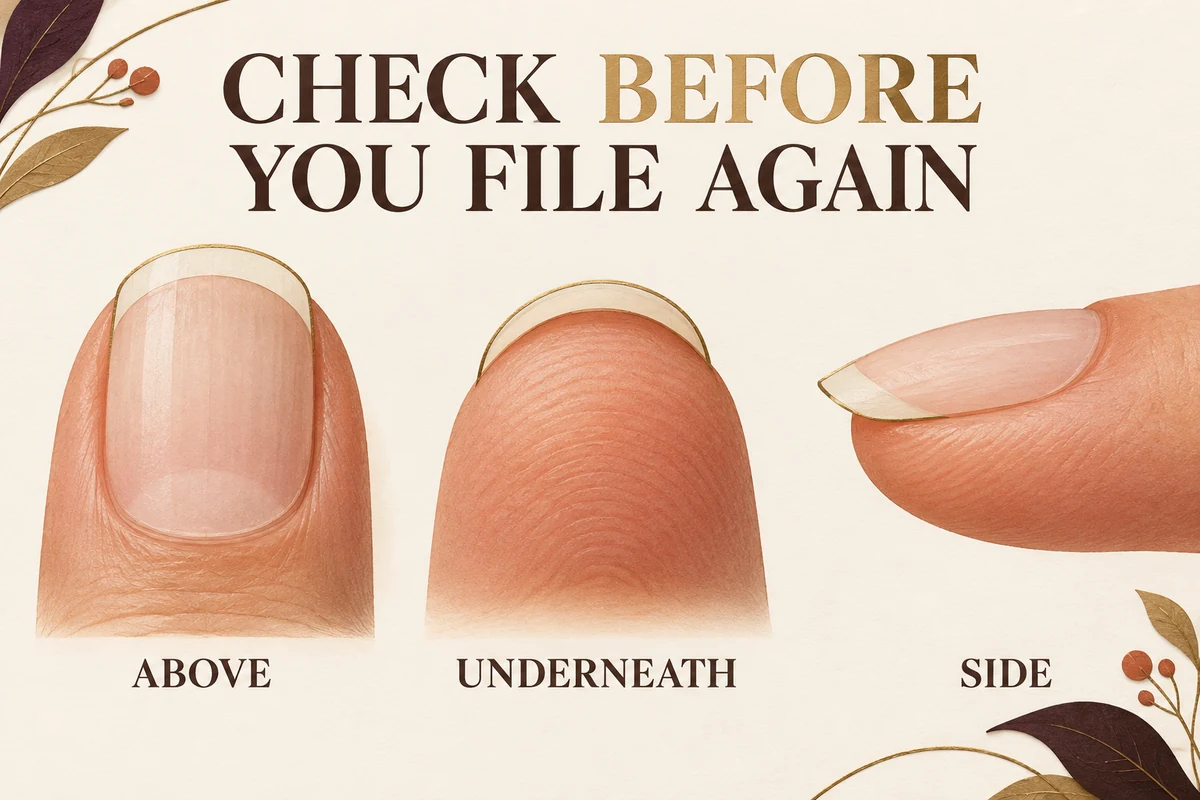
Check three views so you do not keep correcting
The top view shows the outline, but it does not reveal every rough bit beneath the edge. OPI's tutorial explicitly checks from above, below and the side. Pause between changes and look at the same nail in those views before comparing it with the next one.
For example, if one corner catches but the rest of the nail is the length you want, concentrate on understanding that edge. Do not automatically shorten the whole nail, then all the others to match. If you cannot resolve it comfortably, leave it for a professional assessment rather than repeatedly filing.
Our oval-versus-almond comparison helps if the uncertainty is the shape itself. A picture of a much longer nail is not a requirement to taper a short nail beyond the length available.
Wet, dry and coated nails need different questions
Manucurist's guide specifies clean, dry, polish-free nails for its shaping routine. Do not infer that this covers filing through an unknown coating. Gel, enhancements and natural nails are different contexts, and removing a coating is a separate task from tidying an exposed natural edge.
If you have a product on your nails, identify it before using a file. The gel-versus-regular-polish guide explains the basic categories. For a split, tenderness or a persistent unexplained change, avoid turning a cosmetic tidy-up into self-treatment; get appropriate advice.
Once finished, clean away dust according to your tool and product directions. Everyday under-nail cleaning belongs to the washing routine, not to digging with the pointed end of a file.
Ask for the edge you want at a manicure
Mesmerising Beauty's nail-care page includes shaping in its Luxury Manicure description. You can explain “keep this length, soften these corners” without knowing the technical name of every shape. Use the current treatment list to select an appointment in Gosforth, or contact the salon about a coating or request the menu does not settle.
Frequently asked questions
Q: Is filing the same as buffing?
A: No. Filing the free edge changes length or outline; surface buffing is a different task with different tools and instructions. Do not use an edge file across the nail plate by default.
Q: Should all my nails end at exactly the same length?
A: That is a preference, not a reason to keep removing length you want. Decide your boundary first and stop before a small correction becomes a much shorter set.
Q: Can I use this routine to remove gel?
A: No. This guide concerns natural-nail edge shaping. Get removal instructions for the exact gel or enhancement instead of treating it as ordinary filing.