
By Mesmerising Beauty Team
Gosforth salon
Mesmerising Beauty is one salon at 77 High Street, Gosforth, NE3 4AA. Use the live treatment list before booking because service details, prices, and durations can change.
Initial Consultation and a Look at Your Feet
A good pedicure starts with a proper look at your feet and a short chat: which areas bother you — hard skin on the heels, rough patches, untidy nails — and what finish you'd like, from shape and length to polish colour. Your therapist will also ask about sensitivities, allergies, and any medical conditions. That last question matters: if you have diabetes, reduced sensation, or circulation concerns, or if anything on your feet looks like it needs a professional medical opinion — a painful or ingrown nail, broken or bleeding skin, suspected infection — the honest answer is a podiatrist or GP first, and a trustworthy salon will say exactly that rather than pressing on.
The consultation also sets fair expectations. Feet that haven't had attention in a long while may take more than one visit to get where you'd like them, while well-maintained feet need only straightforward upkeep.
Soaking and Softening
Feet soak in comfortably warm water for ten to fifteen minutes — longer than a manicure soak, because the skin on feet is thicker and takes more softening. The soak makes hard skin easier to work on, softens the cuticles for safe tidying, and is frankly one of the nicest parts of the appointment.
Many salons add salts or a few drops of essential oil to the water — pleasant, scented touches that make the soak feel more indulgent. Water temperature is kept warm rather than hot, and topped up as it cools. Any old polish is removed before or during the soak so the nails can be properly seen and assessed before new colour goes anywhere near them.
Toenail Care and Shaping
Toenails are trimmed with proper clippers, cutting straight across rather than curving deep into the corners — the standard careful technique for toenails. Length is left slightly proud of the toe tip; cutting nails too short is uncomfortable and does the toes no favours.
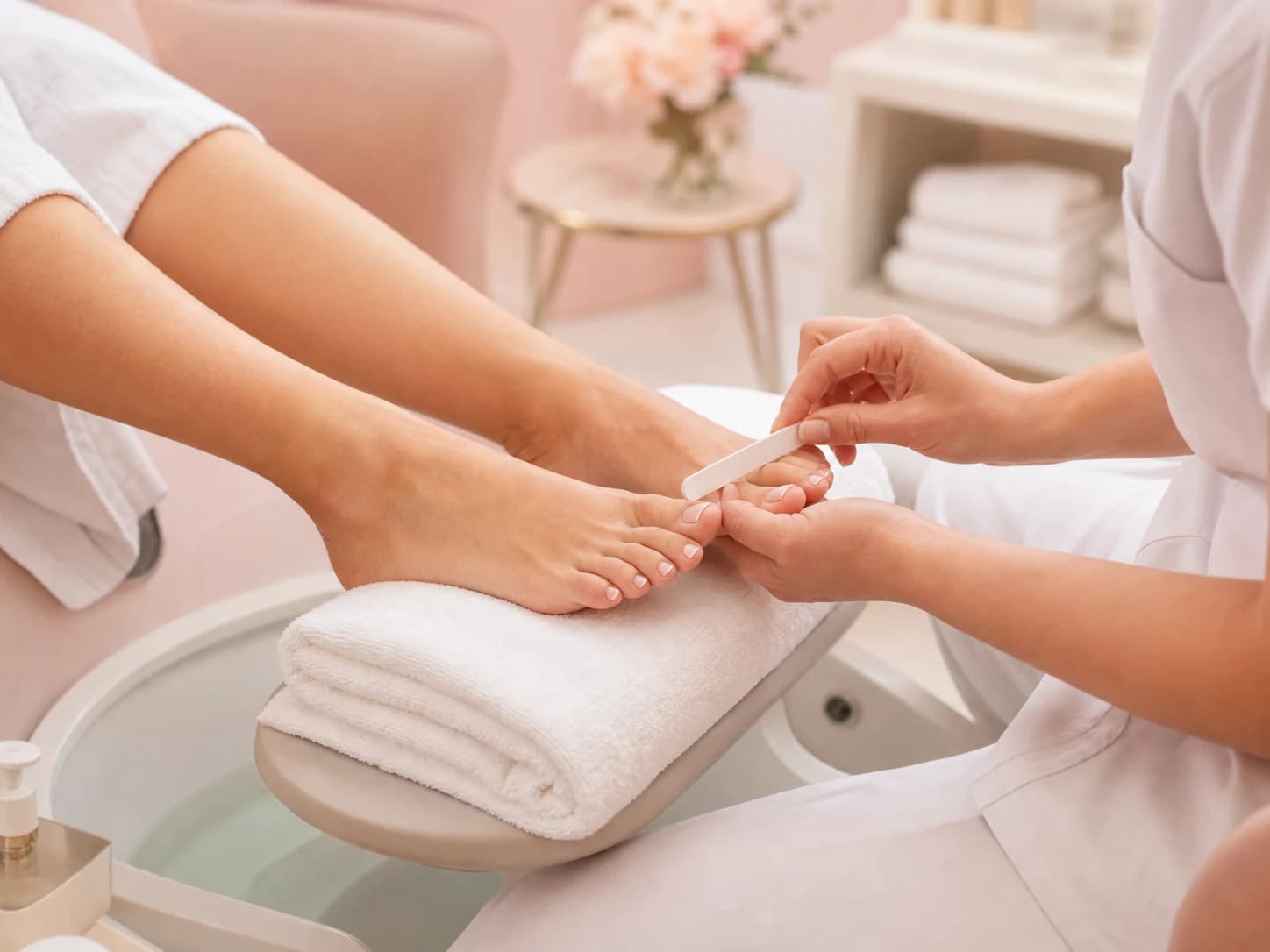
Filing then smooths the cut edges so nothing catches on socks or bedding, refines the shape, and tidies any minor splitting at the free edge, always in single-direction strokes. A conservative buff evens the nail surface ready for polish — conservative because toenails take daily pressure inside shoes and deserve to keep their thickness.
Cuticle Tidying
A cuticle softening solution goes on and is given a few minutes to work. Toenail cuticles tend to be thicker and tougher than fingernail cuticles, so this softening stage is not rushed.
Cuticles are then eased back gently with a wooden or rubber-tipped tool, and any clearly dead tissue or hangnails are trimmed with sterilised nippers — nothing more. The living skin around the nail is left alone; a trained therapist knows the difference and works accordingly. Cuticle oil or conditioning cream massaged in around each nail finishes the stage, leaving the whole nail area neat and comfortable.
Hard Skin and Callus Work
Your therapist assesses where hard skin has built up — typically heels, the balls of the feet, and the edges of the big and little toes — and reduces it gradually using foot files or a pumice. The watchword is moderation: feet naturally carry some firmer skin in the places that take pressure, and stripping it all away in one enthusiastic session is neither comfortable nor sensible. The aim is smoother, more comfortable-feeling feet, achieved patiently.
Heels get particular attention, with careful filing followed by rich moisturiser worked into the area. Deeply cracked or broken skin, though, is a different matter — that's one for a podiatrist or pharmacist, not a foot file. And a simple rule worth remembering about any pedicure: it should never hurt. If anything feels raw or sore, say so at once — careful therapists check in as they go.
Exfoliation and Scrub
A sugar or salt scrub works over the whole foot and up the lower leg to mid-calf in circular motions, smoothing rough texture beyond the obvious hard-skin areas. Extra attention goes to heels and toes; the result after rinsing is skin that feels uniformly smoother and looks brighter.
Thorough rinsing matters — any leftover grit would spoil the massage that follows and stop moisturiser absorbing properly.
Massage and Moisturising
The foot and calf massage is the heart of the treatment for many clients: ten to twenty minutes of unhurried work over the soles, each toe, the ankles, heels, and calves, using a rich foot cream or oil. It is deeply relaxing — that's the honest sell, and it needs no dressing up.
Foot creams are formulated for the job, with softening and hydrating ingredients suited to thicker skin that spends its life in shoes. Some pedicures add a warm paraffin wax dip: feet are cocooned in warm wax for ten to fifteen minutes, which feels wonderful and leaves the skin noticeably softer when it peels away.
Polish Application
If you're having colour, nails are first wiped with a prep solution so polish bonds to a clean, oil-free surface. Toe separators keep everything tidy during application.
Base coat protects the nail from staining and smooths the surface; colour then goes on in two thin coats for even, durable coverage — toenails are small, so precision matters more than speed. Top coat seals the colour and adds shine, wrapping slightly over the free edge. Toenail polish generally has an easier life than fingernail polish, since toes see less water and contact through the day — though exactly how long any polish lasts varies by person and lifestyle. Quick-dry drops can speed things along, but a gentle half hour in open shoes is still the kindest way to leave.
Regular Polish, Gel, or Bare?
The finishing stage comes with genuine choices, and it's worth knowing them before you're in the chair. Regular polish is the classic: a wide colour range, easy to change at home, and simple to touch up. Gel polish is applied in the same careful thin layers but cured under a lamp as it goes, so you walk out with the finish already hardened — no anxious shuffle to the car in foam slippers — and with a high-gloss look many clients choose for holidays and occasions. The trade-off is removal: gel should always be soaked off properly, at the salon or with patience at home, never picked or peeled away, because picking takes the top layers of the nail along with it.
And bare is a perfectly good answer too. Plenty of clients book the full treatment — soak, nails, cuticles, hard-skin work, scrub, massage — and finish with a natural buff and nothing else. The feet still look thoroughly cared for; polish is the optional flourish, not the point of the appointment.
How Long Does All of This Take?
It depends on the level of service you book. An express tidy-up covering nails, shape, and polish is naturally quicker; a full pedicure with the complete soak, hard-skin work, scrub, massage, and polish takes a comfortable stretch longer; and luxury versions with additions like paraffin wax stretch further still. We've answered this properly in How many hours is a pedicure? — but the short version is: don't book a full pedicure into a squeezed lunch break. The treatment is at its best, and so are you, when nobody is watching the clock.
The Hygiene You Should Expect to See
A good salon's hygiene should be visible without you having to ask. Metal tools cleaned and sterilised between clients; files and buffers that are single-use or yours to keep; foot baths cleaned properly between appointments; fresh towels for every client; and a therapist who washes their hands before touching yours or your feet. At Mesmerising Beauty we're happy for you to ask about any of it — a salon that bristles at hygiene questions is telling you something useful.
What to Wear and What to Tell Us
Small practicalities make the appointment smoother. Loose trousers or a skirt let the lower-leg scrub and massage happen without a soggy hem, and open-toed shoes or flip-flops in your bag mean freshly polished toes travel home unsmudged. Arriving with old polish on is completely fine — removal is part of the service. And do tell your therapist anything relevant: allergies or sensitivities to products, ticklish feet (genuinely useful information), any care you're receiving from a podiatrist, and anywhere you'd like a gentler touch.
Looking After the Results Between Visits
A little home care keeps things pleasant between appointments: work a rich foot cream in regularly — bedtime is the easiest habit to keep — file lightly at the heels now and then rather than letting hard skin build for months, and trim toenails straight across if you shorten them between visits. Never pick at gel polish. And if a nail or patch of skin starts to hurt, change, or worry you between appointments, that's a question for a pharmacist, GP, or podiatrist rather than something to save up for your next pedicure — worth repeating, because it's the single most useful piece of foot-care advice a salon can give.
How Often Do People Rebook?
There's no official schedule, and anyone who hands you one is guessing. It genuinely varies by person: how quickly your nails grow, how readily your feet build hard skin, the season — sandal weather concentrates the mind wonderfully — and how much you simply enjoy the hour to yourself. Some clients book regularly all year round; others reappear each spring. When you're ready, you can book online or look over the current price list first.
Pedicures at Mesmerising Beauty
Mesmerising Beauty serves clients from one salon at 77 High Street, Gosforth, Newcastle upon Tyne, NE3 4AA.
For current treatment prices, appointment times, and availability, use the live booking route: